
In The Evolving Self (1982) and In Over Our Heads (1994), Harvard developmental psychologist Robert Kegan described a sequence of qualitatively different ways that human beings organize experience. These are not personality types, and they are not levels of intelligence. They are answers to a stranger question: where does the boundary between “me” and “what I can think about” sit?
At each stage, some part of experience is subject. That is, it’s so close to the self that it cannot be examined, because it is doing the examining. Development is the slow, sometimes painful process by which what was subject becomes object: something the self can see, question, and manage. (The full mechanism is laid out in How the System Works.)
Kegan numbered the stages 0 through 5. The early ones belong to childhood; the later ones (the ones this site mostly cares about) describe the developmental landscape of adult life. Research by Kegan and his colleagues suggests that most adults make meaning at Stage 3 or in the long transition between 3 and 4, that a substantial minority reach Stage 4, and that Stage 5 is genuinely rare, almost never appearing before midlife.
The five stages
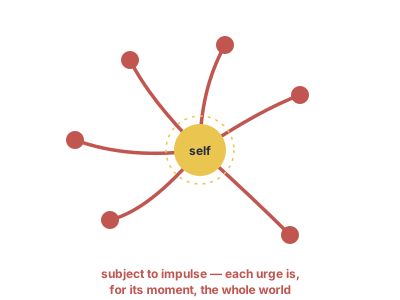
The Impulsive Mind
Roughly ages 2–6. The child is its impulses and perceptions; it cannot yet hold them still enough to manage them.
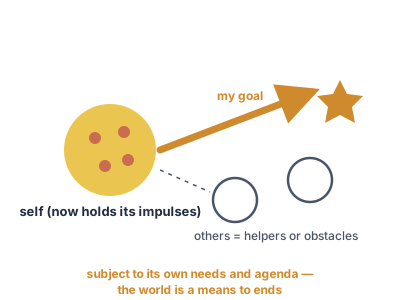
The Imperial Mind
Older childhood and adolescence; persists in some adults. The self has durable needs and pursues them; others matter as helpers or obstacles.
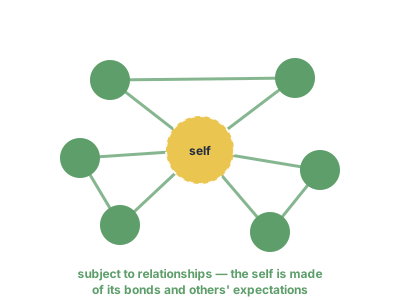
The Socialized Mind
The most common adult stage. The self is constituted by its relationships and the expectations of its communities.
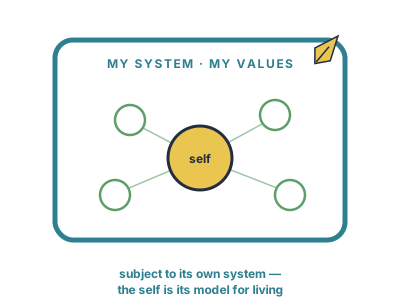
The Self-Authoring Mind
The self writes its own ideology and steers by it. Reached by perhaps a third of adults, usually in adulthood’s middle decades.
The Self-Transforming Mind
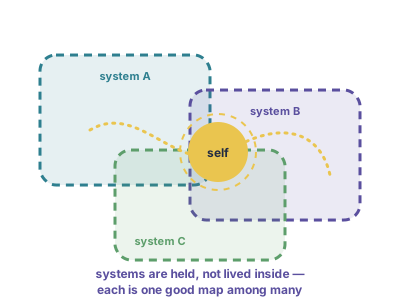
Systems themselves become objects: useful, partial, swappable. Rare, and rarely seen before midlife.
At a glance
| Stage | Subject (what you are) | Object (what you have) |
|---|---|---|
| 1 · Impulsive | Impulses, perceptions | Reflexes, sensations |
| 2 · Imperial | Needs, interests, desires | Impulses, perceptions |
| 3 · Socialized | Relationships, shared values, others’ expectations | Needs, interests, desires |
| 4 · Self-Authoring | One’s own ideology, identity, system of values | Relationships, shared values |
| 5 · Self-Transforming | The movement among systems; the process of meaning-making itself | Ideologies, identities, systems |
Two ways to read the rest of this site
The stage pages describe developmental stages: ways of being a person that you grow into and become native to. But the numbers also work as pattern language. E.g. you can call a behavior “3-patterned” without claiming anything about anyone’s native stage of development. The distinction matters enough that it has its own page, and the most common ways the whole framework gets misread have another.