
Overview
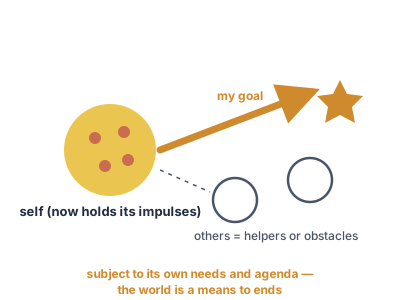
Somewhere in the school years, a child stops being its impulses and starts having them. What stands behind the impulses now is a set of durable needs, preferences, and projects. This makes up an agenda that persists from morning to night and from month to month. Kegan called this the Imperial balance: the self has become a little sovereign state, with interests to advance and defend.
This is real progress. The Imperial Mind can plan, delay gratification, follow rules, and make deals (none of which Stage 1 could manage). But it relates to everything, including people and rules, through the question what does this mean for my agenda? Rules are obeyed because of consequences, not because of shared values. Other people are understood to have needs of their own, but those needs matter as facts to negotiate around. They are not felt or cared about from the inside.
This is the native stage of late childhood and early adolescence. Some people remain organized this way well into adulthood, where the same structure reads as transactional: relationships as exchanges, ethics as cost–benefit, loyalty as leverage.
Subject — what it is
Its needs, interests, and desires. The agenda cannot be questioned, because the agenda is the self.
Object — what it has
Impulses and perceptions which are now visible, delayable, and manageable in service of the agenda.
What it looks like
- “What’s in it for me?” is not intentional cynicism. It is the only available frame.
- Rules are external physics: real, binding, and binding because of consequences.
- Reciprocity is concrete. It’s about tit-for-tat, deals, fairness as equal shares.
- Guilt is mostly fear of getting caught. The inner court of others’ expectations hasn’t yet been seated.
Stage 2 as a pattern
As pattern language, “2-patterned” names transactional moves anyone can make: keeping score in a marriage, working to rule, optimizing a metric because the metric is what gets rewarded. Institutions can run 2-patterned incentive systems regardless of the developmental stage of anyone inside them. Saying “that negotiation went full 2” describes the pattern, not the people.
The move beyond
The Imperial Mind’s limit is that it cannot hold its own needs as object, so it cannot subordinate them to something larger. When needs finally migrate to object, what forms behind them is a self made of relationships: the ability to internalize another’s point of view so deeply that it becomes part of you. That is Stage 3, the Socialized Mind — the stage where most of adult life is lived.