
Overview
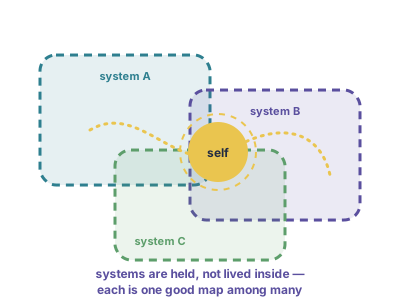
At Stage 4, the self is its system. That is, one coherent framework, defended at the border. The Self-Transforming Mind has made that last structure object. It still has values, commitments, and expertise, but what has changed is its relationship to them. A framework is now a tool: reached for, applied where it has utility, set down where it doesn’t, and never mistaken for the world itself.
The Stage 5 person expects every system, including their best one, to be incomplete somewhere; so contradiction stops being an emergency and becomes information. They can argue position A in the morning and steel-man position B in the afternoon, not from slipperiness but because they can feel where each map fits the ground. Identity survives reframing, so being deeply wrong is interesting rather than annihilating.
Kegan found this structure genuinely rare and essentially absent before midlife. This makes sense, since you likely need to exhaustively run a self-authored system into its edge cases before the system’s limits become vivid enough to hold.
Subject — what it is
The movement between systems. That is, the ongoing process of meaning-making itself, which still can’t be stepped behind.
Object — what it has
Ideologies, identities, and frameworks (including its own), which are held as partial, useful, revisable maps.
What it looks like
- Comfort with paradox: two incompatible framings can both be kept on the bench, each used where it works.
- Fundamental challenges to one’s worldview are met with curiosity rather than border defense.
- Less need to win the frame war in a conflict; more interest in what each frame reveals and hides.
- From the outside it can read as inconsistency or evasiveness. To a 4-patterned eye especially, which wants to know which system you actually believe.
Stage 5 as a pattern
As pattern language, “5-patterned” names moves that treat frameworks as objects: switching analytical lenses mid-problem because the first one stopped working, designing a process that expects its own assumptions to fail, holding a debate where each side must argue the other’s case. Anyone can execute a 5-patterned move occasionally. What marks the native is doing it under pressure, about the framework they love most.
Beyond?
Kegan’s model stops here, and he was careful to note that Stage 5 is not the end of difficulty. It is one more rebalancing, with its own characteristic strains. Whether there is meaningful structure past it is an open question the data so far is too thin to answer.